

Inser Industry · For non-durable consumer goods producers Your main line already runs fast. What surrounds it decides how much you produce.
Your product is yours to make. We bring the judgement, the design and the integration so your plant produces more with the line it already has.
- 1987automating since then
- +1,000projects delivered
- +600customers
- 17countries
The bottleneck sits in what surrounds the process machine.
In a consumer goods plant the investment usually sits in the main line: filler, packer, printer, extruder. It runs fast and it is measured.
But the plant’s real output is set by receiving, the auxiliary processes, the end of line, storage and shipping, which still depend on people, on shifts, and on how many format changes there are that day.
Almost nobody measures those stoppages separately, so almost nobody knows what they cost. The first thing we do is put a number on them.
Where the shift goes
- The format change. Every new product means an adjustment, and the adjustment is made by whoever knows how. If they are not there, it does not get changed.
- The end of line. Case packing, palletising, wrapping and labelling by hand set the pace for everything upstream.
- The auxiliary processes. Feeding, clearing, moving between stations: they appear in no indicator and they eat the hours.
- Shipping. The last-minute peak goes out however it can, and that is where the mistakes that reach the customer are made.
None of these four is fixed by buying a faster process machine.
The investment
- Hard to justify the investment when the line «already works»
- Uncertainty when sizing the end of line for seasonal peaks
- Little visibility to see where the product piles up
On-time delivery
- Every format change drags the whole line with it
- Many formats and promotions that arrive at short notice
- Hard to keep up with a season calendar that keeps moving
The machine
- Micro-stoppages that nobody ever counts
- The setting comes out differently depending on who is on the machine that day
- Slow setting every time a new format comes in
From raw material to truck
Your line in the centre. Six zones around it.
The main line is yours and it stays untouched. Everything else works to its pace to keep it fed. Tap a zone on the layout and see what we solve there, how, and with what.
01 Receiving and feeding
The challenge
So the main line never waits for a container, a case or a consumable. Today it depends on who is there to bring the pallet down and take it to the machine.
How we solve it
Automatic depalletising of containers, cases and raw material, and feeding of the line and its consumables, so the process machine works without gaps.
With what
- Depalletising layer by layer or case by case
- Automatic loading of case formers, blanks and consumables
- Conveying to the line infeed, at the machine’s pace
02 Auxiliary processes
The challenge
Grouping, orienting, counting, weighing or inspecting between one machine and the next: tasks nobody measures, which stop the line when the person doing them is missing.
How we solve it
Vision-guided picking, grouping and in-line checking, integrated with the process machine and at its pace, whoever made it.
With what
- Machine-vision picking, with no need to position the product first
- Grouping and layer forming
- In-line quality checking, weighing and counting
03 Case forming and case packing
The challenge
Every new format means an adjustment, and the adjustment is made by whoever knows how. If they are not there, it does not get changed; and in peak season it gets changed many times.
How we solve it
Case forming, packing and sealing with format changes by recipe: a collaborative robot when variety rules, a closed cell when throughput rules.
With what
- Case and box-pallet forming
- Packing by layers, by gravity or piece by piece
- A collaborative robot alongside people, with no fencing
- Format change by recipe, from the screen
04 Palletising
The challenge
Different patterns for each customer and each destination, twenty-kilo loads by hand, and the last-minute peak going out however it can.
How we solve it
Robotic palletising of cases, sacks, trays or box pallets, with each customer’s pattern programmed without stopping the line.
With what
- Patterns by customer and by destination, with no reprogramming of the robot
- Cases, sacks, trays and box pallets
- One or several lines to a single robot
- Automatic feeding of empty pallets and slip sheets
05 Wrapping, labelling and checking
The challenge
So the pallet leaves stable, identified and counted before it goes on the truck, and not after a complaint.
How we solve it
Wrapping, strapping, top cover, labelling and pallet verification: the end of line is closed before shipping.
With what
- Automatic wrapping and strapping
- Top cover and edge protectors
- Pallet label carrying the order data
- Dimensional checking and traceability for every pallet
06 Storage, orders and shipping
The challenge
Emptying the warehouse and building each order by hand, with forklifts crossing paths with people on the way to the dock and the last-minute peak on top.
How we solve it
Automatic unloading of the warehouse, order building with case picking and mixed pallets, and transport with AGVs and mobile robots out to the dock, integrated with your warehouse management system.
With what
- Unloading the warehouse and feeding the order-building area
- Order building: case picking and a mixed pallet per order
- AGVs and mobile robots with natural navigation, with no building work
- Integration with the plant’s WMS and ERP
For whoever answers for the plant not stopping
Six questions. Yes or no. Thirty seconds.
Written for whoever decides who to work with over the next few years, not which machine to buy tomorrow. At the end we tell you where we would start.
-
1 / 6
Does your main line ever wait for someone to bring it containers, cases or consumables?
Receiving and feeding: so the process machine never waits for a pallet.
-
2 / 6
Does every format or season change depend on two or three particular people?
Case forming and packing with format changes by recipe: the change is made by whichever shift is on.
-
3 / 6
Does palletising, or keeping each customer’s pattern, set the pace of your shipping?
Robotic palletising with each customer’s pattern programmed, without stopping the line.
-
4 / 6
Do your big customers audit the quality, labelling and traceability of every pallet?
In-line checking and an end of line that identifies and counts every pallet before it leaves.
-
5 / 6
Do you build orders by hand, with forklifts crossing paths with people on the way to the dock?
Warehouse unloading, order building and transport with AGVs and mobile robots out to shipping.
-
6 / 6
Do you have several lines or plants automated by different suppliers, with nobody answering for the whole?
A plant plan with one party responsible: we emulate the whole thing, decide with you where to start, and answer for the performance, with our own technical service.
Your result
This is where we would start.
- 01Receiving
- 02Auxiliary processes
- 03Case packing
- 04Palletising
- 05Wrapping
- 06Shipping
- +Plant plan
If none of this applies to you, the interesting conversation is a different one: how much capacity you will need in the coming seasons and whether today’s plant can take it. That is answered by emulating.
What other producers answer
Take it with you. Scan and take your result with you, along with the whole page to read at your own pace.
First you decide on data. Then you automate.
Three levers, in this order: measure, put the format sequence in order, and only then automate. The other way round, you automate a problem.
Emulate
Decide on data, not on last season’s history
- Simulate the line with the real format mix
- Compare case packing and palletising configurations
- See the seasonal peak coming before it arrives
- Reduce the risk of a long stoppage at start-up
- Validate the investment against the space and the pace you already have
Plan
Fewer format changes, more cases per shift
- Group the formats so the change costs less
- Set the production sequence for the week
- Hold the pace when a promotion arrives unannounced
- Gain room to manoeuvre in short-term planning
- Get more out of the line already installed
Automate
Less manual setting, more production
- Do away with setting by hand at every format change
- Cut set-up times
- So changing format does not depend on one person
- Raise the end of line’s uptime
- Bring down the micro-stoppages, which is where the shift goes
- Less weight and fewer awkward postures at the end of line
Before deciding anything, the end of line running in software.
Emulating it with your real format mix answers the question that actually holds a project up: whether the investment is sized for the seasonal peaks, and not just for a quiet Tuesday.
Before you invest
To design the system
- Test machine configurations with real production data
- Define the best architecture for each plant
- Validate performance before anything is installed
- Lower the risk of the investment: neither oversized nor short
And every day after that
For day-to-day production
- Simulate production scenarios with many products
- Work out the best production sequence
- Cut changeover times between machines and materials
- See bottlenecks coming and raise output
- Decide with data, on the day, not at next month’s meeting
What can be measured
Figures measured on our own lines.
80,000
3,900
75 %
4.8/5
How the decision gets judged
OEE, OTIF and ROI: the three figures you will have to defend.
You close the number with your own costs. We give you the data it comes from: the emulation hands you the end of line’s real throughput, what each format change costs and the stoppages that pile up.
OEE
Overall equipment effectiveness (OEE)
What the line produces against what it would produce if it never stopped and everything came out right first time. Three factors multiply together, and in an end of line with many formats the one that drops most is nearly always the middle one.
What you get: The emulation gives you the three separately, station by station and format by format, before the line exists.
OTIF
Deliveries on time and in full (OTIF)
An order only counts if it arrives on the agreed day with everything in it. It is the figure your customer looks at, and the first to suffer when a peak season hits.
What you get: It can be tested beforehand: we put a seasonal peak or a new format into the emulation and see what holds.
ROI
Return on investment (ROI)
It is calculated with your costs and your prices, not with ours. That is why we do not promise it: what we provide is the part of the calculation that can be checked.
What you get: Cases per hour, stations needed, how busy each one is and expected downtime. With that, the number is yours to make and yours to defend.
All three are worked out from the same data. That is why the emulation comes before the investment is committed, not after the line is built.
On video
Filmed in plants that produce every day.
Clips of our own installations, from the case to the truck. No animations, no simulations.
Frozen food, from the bag to the pallet
Packing bags of frozen product and palletising in a temperature-controlled room.
- On site
References
We work in 17 countries
And there are consumer goods lines of ours in Spain, Portugal, France, Germany, the United Kingdom, Norway, Argentina and Brazil. All of them designed in Mungia.
- Mungia, where it is designed
- Country where we work
- Area with a consumer goods line of ours
FMCG producers already working with us.
Plus more than 600 customers in 17 countries, across every sector.

















Different products, the same end of line
-
01
Food and frozen
High volume, tight margins and customers who audit. A twenty-minute stoppage shows up in the month-end figures.
-
02
Beverages
Thousands of containers an hour: the end of line has to go as fast as the filler, or the filler waits.
-
03
Paper and tissue
Bulky, light, delicate product. The handling is the process, not an accessory to it.
-
04
Chemicals, detergents and agriculture
Rigid containers, sacks and heavy loads: where palletising by hand does the most harm.
-
05
Cosmetics, personal care and supplements
Enormous format variety and short runs. This is collaborative robot territory: reprogrammed rather than redesigned.
-
06
Packaging and board
Tubes, reels and cases: industrial product packed and palletised like FMCG.
Who answers when the line stops in the middle of peak season?
Our own technical service. Three out of four incidents are resolved without leaving Inser, through a remote connection, and when someone has to travel, they travel. Wherever the plant is.
- 1 Remote support An immediate connection, with no waiting for anyone to arrive.
- 2 On-site intervention For when someone has to be in front of the machine.
- 3 IoT platform Warnings before the stoppage, not reports afterwards.
- 4 Training and handover So your night shift does not depend on ours.
Brochure
End of line, the whole booklet
Sixteen pages: from case forming to pallet movement. Turn it the way you turn paper.

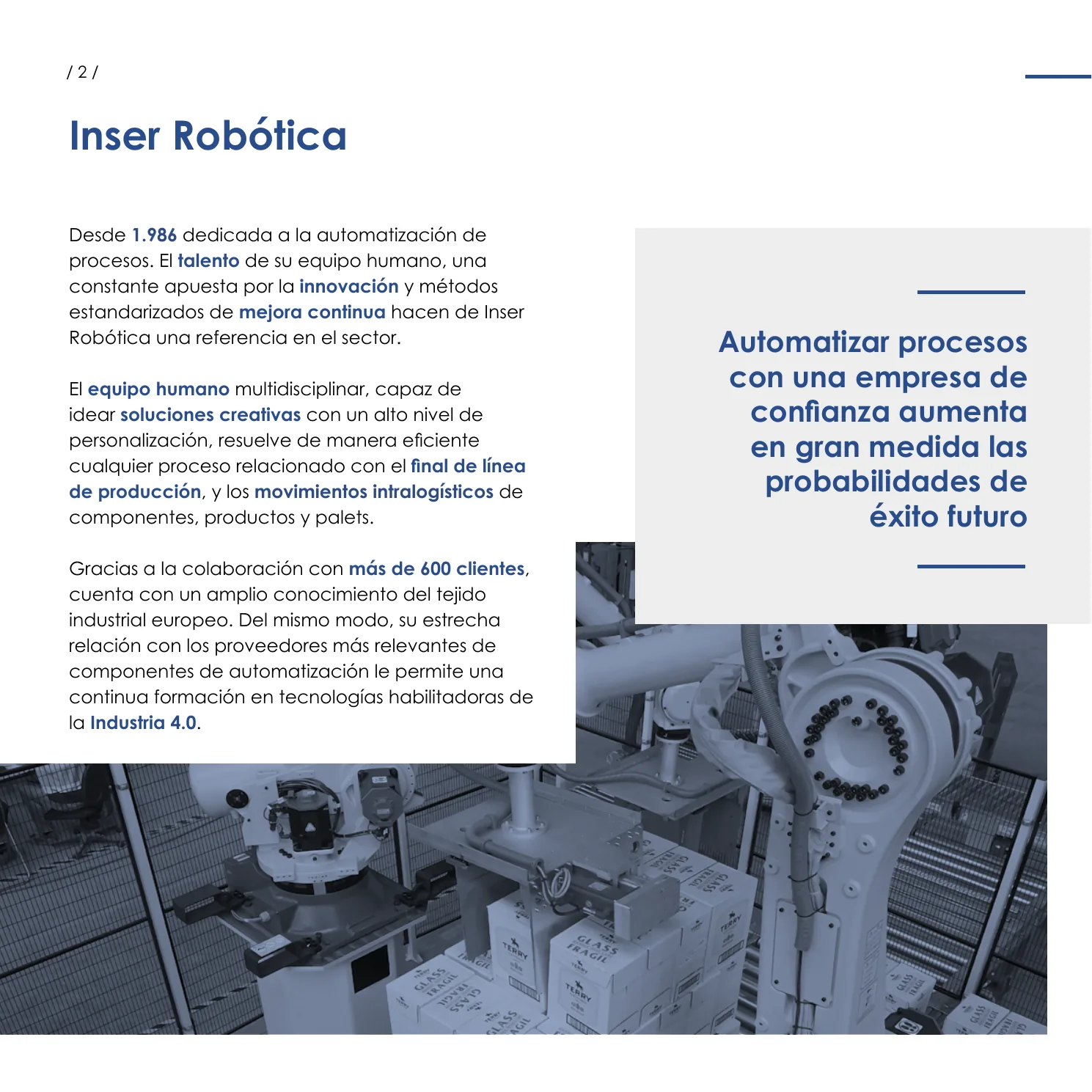

Drag the page, or use the arrow keys.
We do not install a palletiser: we answer for what comes off the end of the line.
Proven experience
Since 1987. More than 1,000 projects delivered and maintained.
Modular and scalable
Modules that go in without stopping the rest of the line.
High throughput
Tight cycles and format changes that do not eat the shift.
Our own software
From planning to pallet, with no seams between systems.
Self-correcting system
It corrects itself, so a new format does not lower quality.
IoT monitoring
Live data from the whole end of line.
From the end of line… to full control.
Because cases per shift do not depend on how many robots you install: they depend on how you order the formats, control the pace and use the line you already have.
Nine answers before the first meeting.
What do you automate in a consumer goods plant?
Everything around the main line: receiving and feeding, auxiliary processes, case forming and packing, palletising, wrapping and labelling, and transport to storage and shipping. The process machine is yours and stays as it is; what we do is make sure nothing around it holds it back.
Do you make the process machine, the filler or the packer?
No. We are an automation engineering company: we bring the judgement, the design, the integration and the support so your plant produces more with the line it already has, and we integrate with the process machine whoever made it.
How are format changes made?
By recipe. Each format has its program and the change is made by whichever shift is on, from the screen, without depending on the specialist.
What happens when a customer arrives with their own pallet pattern?
The new pattern is programmed without reprogramming the robot or stopping the line.
Can it be automated in stages?
Yes. Each module works on its own or combined with the others, and it is sized with what is coming in mind, so it can grow without rebuilding what is already installed.
How do you know the investment can take the seasonal peaks?
By emulating the end of line with your real format mix and your throughput before anything is built. It is how you see whether one station is unnecessary or another will fall short at peak.
Can you work with several plants in the same group?
Yes, with each plant separately or with the group, with one point of contact for the whole and the same technical service for all of them.
Who answers when the line stops?
Our own technical service, Inser Services. Three out of four incidents are resolved without leaving Inser, through a remote connection, and when someone has to travel, they travel.
Who is Inser Robótica?
An industrial automation and robotics engineering company founded in 1987 in Mungia (Bizkaia), with more than 1,000 projects delivered, more than 600 customers and work in 17 countries. It designs, builds and starts up its own installations, and maintains them through its technical assistance division, Inser Services.
The latest we have written about end of line and palletising.

December 2025
Why programming matters in the robotic automation of industrial processes in Spanish
Programming plays an important part in the robotic automation of industrial processes such as those at the end of the line

May 2025
La Fábrica Nacional de Moneda y Timbre automatiza su final de línea de fabricación de pasaportes in Spanish
Llevaremos a cabo el desarrollo de dos células de encajado y paletizado de pasaportes en la sede de la FNMT en Jorge Juan, Madrid.

December 2023
The age of robots: pioneers in industrial automation and efficiency in Spanish
How advanced automation is transforming industry and improving efficiency in modern manufacturing.
Think better automation
- Wider vision Look at the whole plant before touching a machine. What slows a line down is almost never where it hurts.
- Right decisions Decide with data: emulating, measuring and putting the numbers on the table before buying anything.
- Higher efficiency More uptime, better quality and processes that hold. Efficiency follows from them.
How many times a day does your line stop because of something that is not the line?
If you have not measured it, that is fine: that is usually the first job. Tell us what your plant is like and we will tell you what we would look at first.
Carry on from your phone. Scan and take the whole page with you. And if you would like us to call, leave your details below.


